
At Water Linked, we’re proud to support the next generation of marine robotics engineers through close collaboration with NTNU’s Marine Robotics program.
This year, we had the pleasure of hosting two outstanding master’s students, Akira Techapattaraporn and Ahmed Borchani, who conducted their thesis research using the Water Linked Sonar 3D-15 and our underwater technology ecosystem.
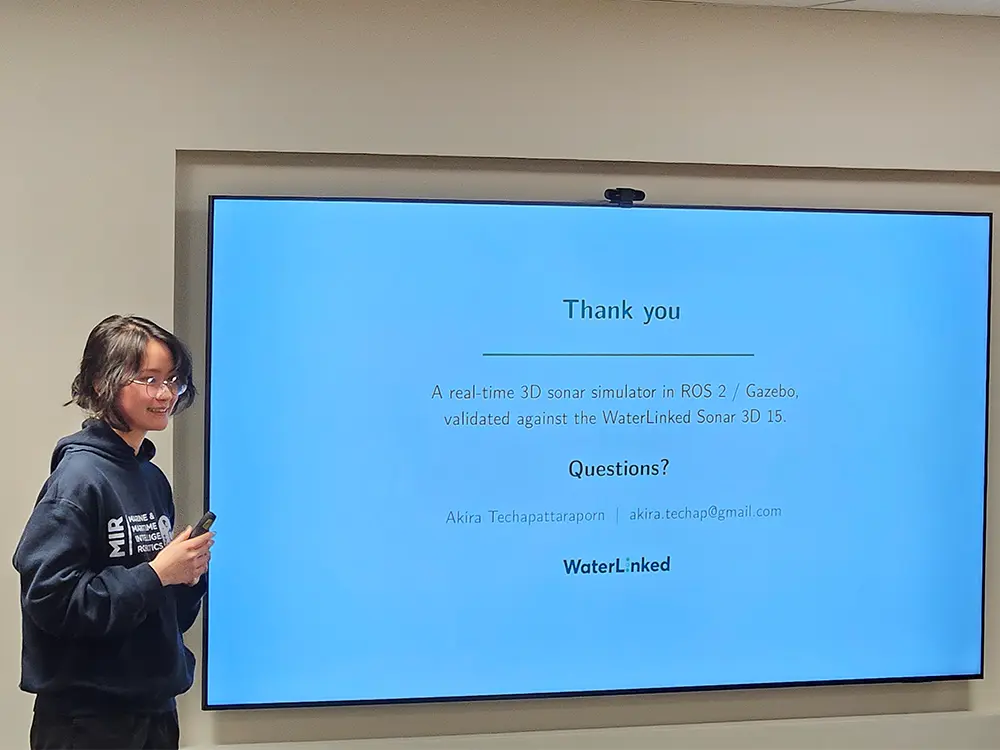
Akira tackled a challenge that has long existed in underwater robotics: realistic sonar simulation. Her thesis developed and validated a 3D sonar simulator integrated into ROS 2 and Gazebo, creating one of the first robotics-focused simulation environments benchmarked against real sonar measurements. By comparing simulated data with real-world Water Linked Sonar 3D-15 observations, Akira established a framework that helps researchers understand where current sonar simulations excel and where future developments are needed.
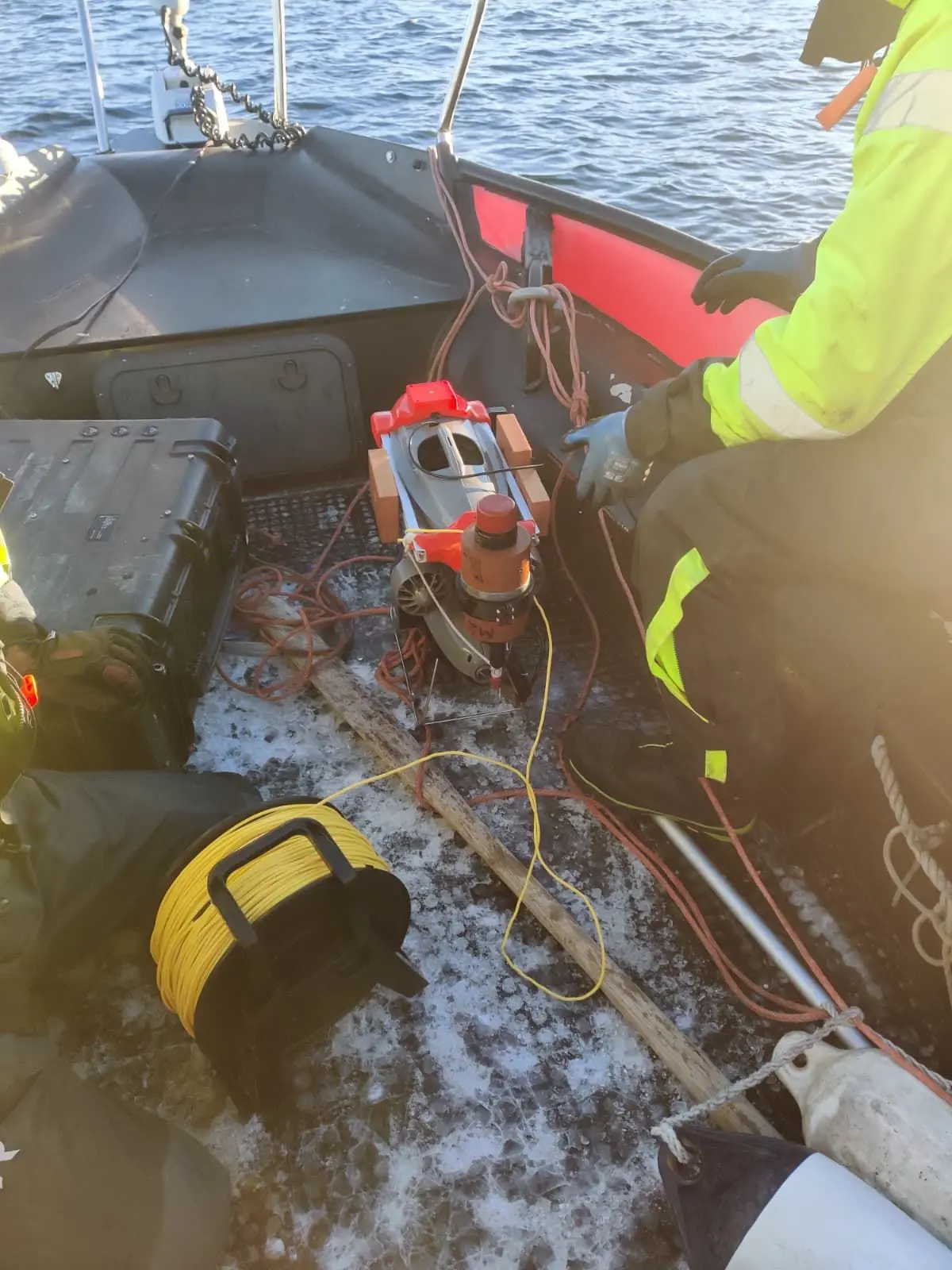
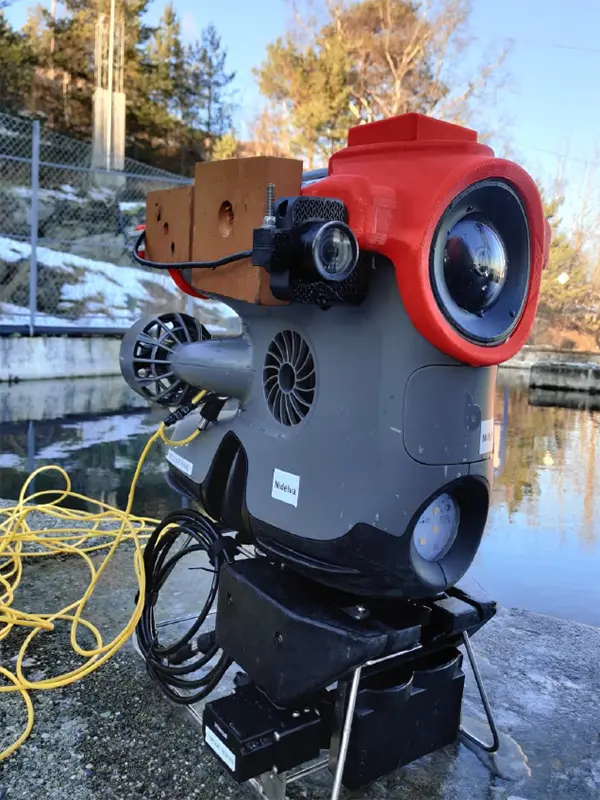
Ahmed focused on underwater navigation and localization. His work explored how 3D sonar data can be used to correct drift in autonomous underwater vehicles by matching sonar scans against known structures and integrating the results into an Error-State Kalman Filter. Through both simulation and real-world testing using a Blueye ROV equipped with the Water Linked Sonar 3D-15 in Trondheim Fjord, he demonstrated the potential of sonar-based navigation for infrastructure inspection without requiring additional acoustic positioning infrastructure.
Their projects highlight the growing role of high-resolution 3D sonar in enabling underwater autonomy. Beyond the research itself, both students spent countless hours testing in fjords, frozen lakes, tanks, and laboratories, turning theory into practice. As Ahmed described it, operating a Blueye ROV with the Water Linked Sonar 3D-15 at 90 meters depth felt “like operating a moon lander”.
We extend our gratitude to Akira and Ahmed for their hard work, curiosity, and meaningful contributions and look forward to following their future achievements in marine robotics.