
After three busy and rewarding days in Vienna, Water Linked has officially wrapped up its participation at ICRA 2026, one of the world's leading conferences for robotics and automation.
The event brought together researchers, engineers, developers, and technology companies from across the globe to showcase the latest advancements in robotics, perception, autonomy, and intelligent systems. For the Water Linked team, it was an excellent opportunity to connect with the underwater robotics community, demonstrate our technology, and learn more about the challenges shaping the future of subsea operations.
Showcasing Sonar 3D-15 and DVL Technology
Throughout the exhibition, visitors stopped by our booth to explore Water Linked Sonar 3D -15 and DVL solutions and discuss how these technologies can support underwater navigation, perception, mapping, and autonomy.
We had the opportunity to speak with a diverse range of professionals from academic researchers and students to commercial operators, system integrators, and autonomous vehicle developers. These conversations provided valuable insights into how underwater robotics is evolving and where reliable underwater sensing and positioning technologies can make the greatest impact.
Whether the discussion centered around cave exploration, underwater inspection, autonomous navigation, environmental monitoring, or next-generation robotic platforms, it was inspiring to see the growing range of applications being developed across the industry.
A Strong Focus on Sonar
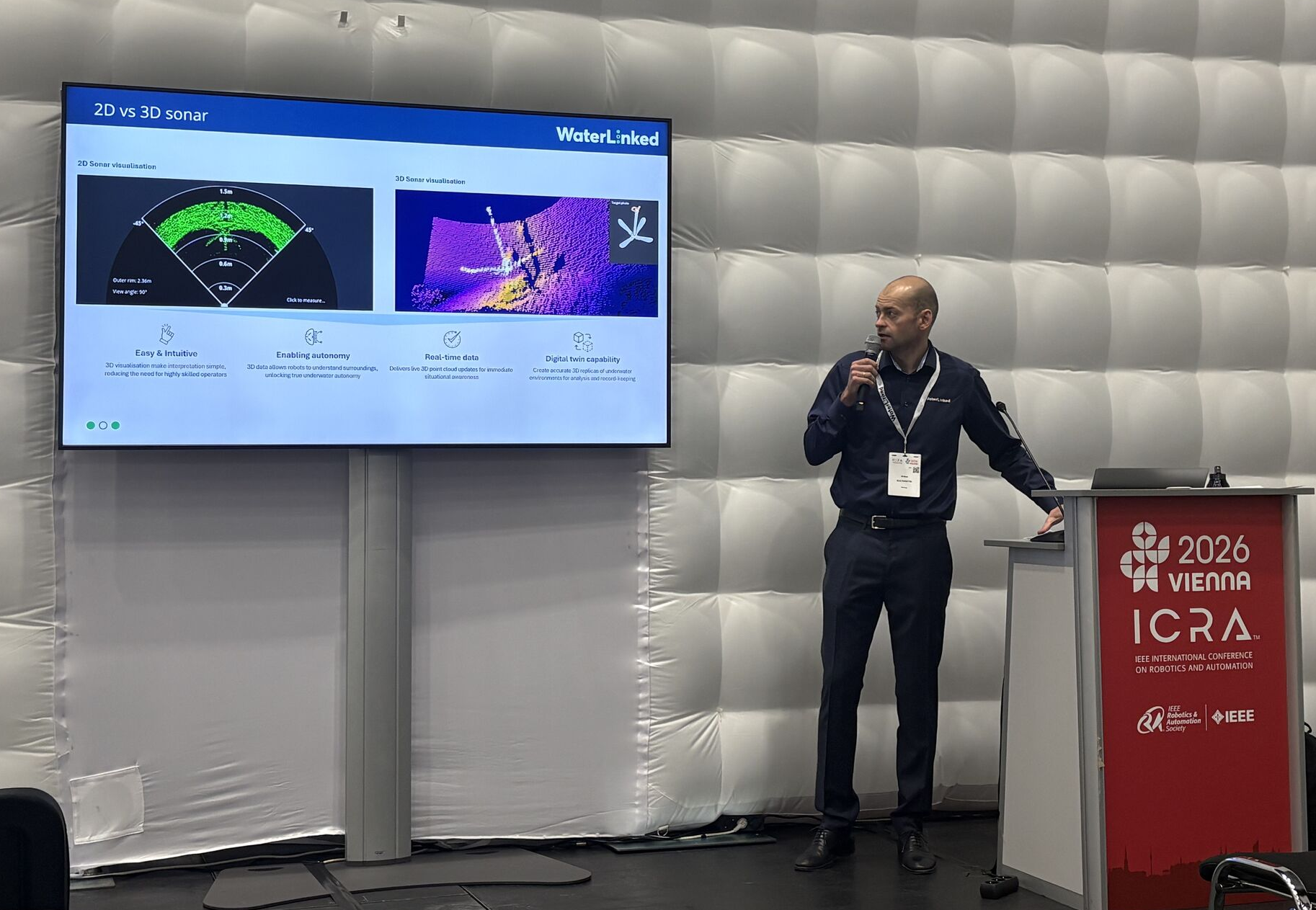
One of the highlights of the week was a technical presentation delivered by Anton Kulyakhtin, one of the key architects behind Water Linked Sonar 3D -15.
The session explored the journey behind the development of the world's first compact 3D sonar, including the challenges that inspired its creation, the engineering decisions that shaped the technology, and the value it delivers for underwater operations where visibility is limited or unavailable.
The presentation sparked numerous follow-up discussions at the booth, giving visitors the opportunity to dive deeper into the capabilities and practical applications of compact 3D acoustic sensing.
Another memorable moment came from our good friend and 3D Sonar ambassador, Marios Xanthidis from SINTEF, who presented his poster:
"Characterization, Calibration, and Estimation Pipelines for the First Compact 3D Sonar."
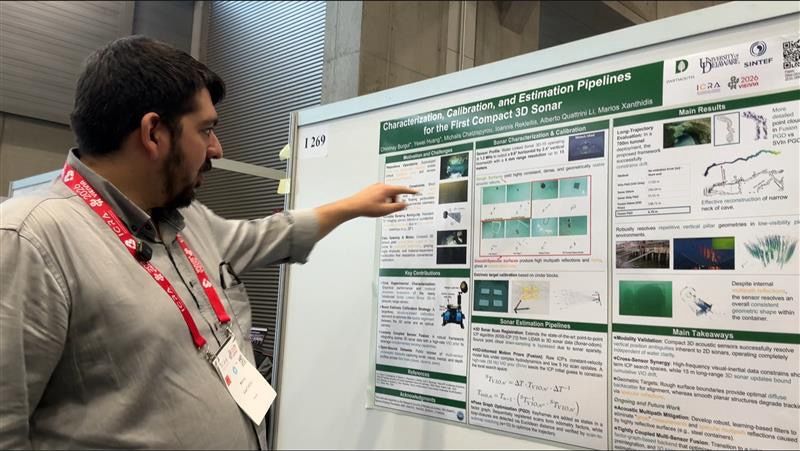
His work demonstrated how compact 3D sonar technology can be characterized, calibrated, and integrated into estimation pipelines for underwater robotic systems, further highlighting the growing role of acoustic perception in challenging subsea environments.
Hands-On Robotics Challenge
ICRA is always about more than presentations and technical discussions. Throughout the exhibition, visitors were invited to participate in our interactive underwater robotics challenge.
Participants took control of an ROV and navigated through a demanding underwater environment in a virtual game, while using Sonar 3D-15 to locate submerged mines and avoid obstacles. The challenge provided a practical demonstration of how sonar-based perception can help operators and autonomous systems perform tasks when visibility is poor or entirely absent.
The competition attracted enthusiastic participation throughout the event and concluded with a prize draw for those who successfully completed the challenge.
Conversations That Matter
While the robots may have been the stars of the show, the most interesting insights came from the conversations around them.
Throughout the week, we met people working on a wide range of underwater applications, each bringing unique perspectives and challenges. From early-stage research projects to commercial deployments in demanding environments, the willingness to share experiences, discuss ideas, and learn from one another continues to make the underwater robotics community a uniquely collaborative space.
Some of the most valuable discussions started with a simple stop at the booth and quickly evolved into deeper conversations about navigation, perception, autonomy, and the future of underwater operations.
Looking Ahead
ICRA 2026 once again demonstrated the incredible pace of innovation across robotics and autonomous systems. We leave Vienna energized by the ideas shared, the relationships strengthened, and the opportunities ahead.
We would like to thank everyone who visited the Water Linked booth, attended our presentations, participated in the ROV challenge, and took the time to share their projects and experiences with us.
Until next time.