
OCEANS 2026 Monterey brought together researchers, vehicle manufacturers, system integrators, defence organisations and marine technology companies working on underwater robotics, navigation, sonar, AI and autonomous operations.
These topics are close to what we work on every day at Water Linked, so Monterey was a good place to see what people are building, what problems they are trying to solve and where our technology fits.
There was a lot of interest in our products, especially our Sonar 3D-15 and DVLs. Our DVL portfolio was recently expanded with the DVL A100 and DVL A250. The interest reinforced the demand we see for compact subsea navigation sensors and real-time 3D acoustic perception.
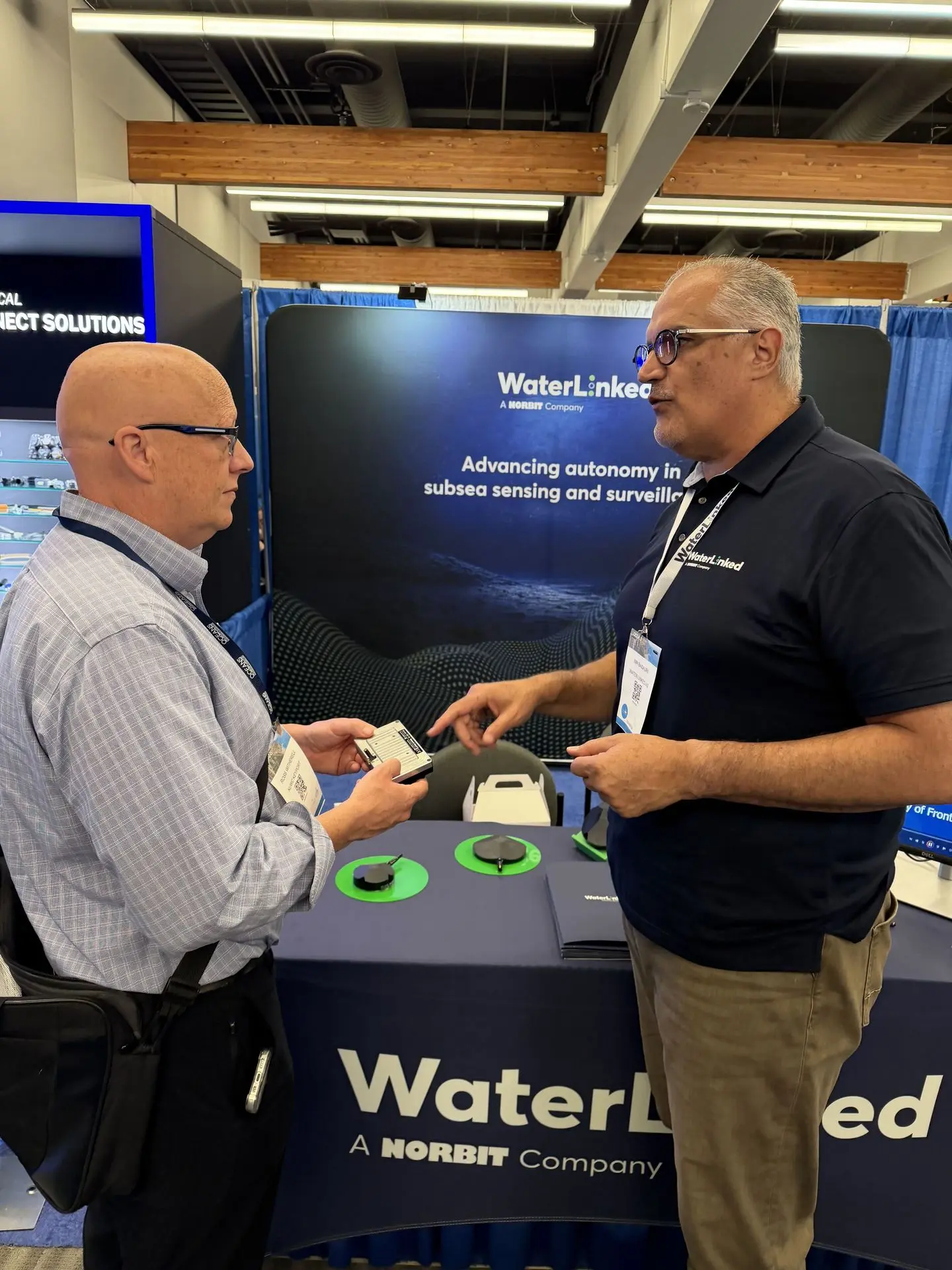
3D sonar in the spotlight
Many visitors came to see Sonar 3D-15 and discuss applications for its real-time 3D data. Some had already encountered the sonar just a few stands away. Our partner Deep Trekker was exhibiting its new SPECTRA ROV, which offers Sonar 3D-15 integration for real-time 3D mapping and spatial awareness. Deep Trekker sent visitors interested in the integration over to our stand, where we could go deeper into the sonar and its capabilities. Deep Trekker offers the integration for inspection and survey work, including operations in high-turbidity water.
It was a good example of the value of working closely with ROV manufacturers. Seeing a sensor on a complete vehicle makes the application concrete; customers can see how the technology could fit into their operations.
The interest at OCEANS also went well beyond general product enquiries. We discussed upcoming projects, budgets, planned purchases and integration requirements, and received quote requests during the event.
For us, these conversations are a useful sign that Sonar 3D-15 is finding its place as a practical tool for underwater robotics.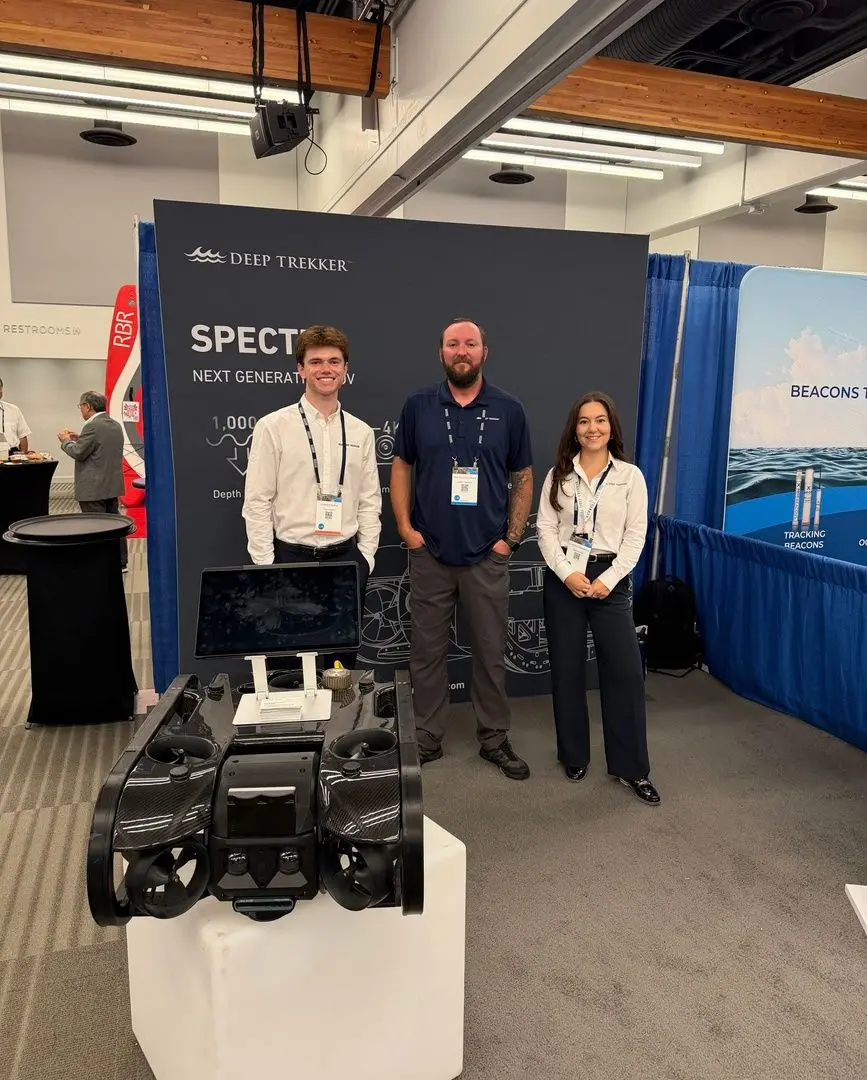
Photo courtesy of Deep Trekker
From ‘what can I see with the Sonar’ to ‘what can I do with the data’
Sonar 3D-15 generates 3D data of the underwater environment in real time. Its integration API can transmit 3D points for live visualisation, analysis or recording, and we provide example implementations for developers working with the data.
So the value is not limited to what you see in the Sonar 3D-15 interface. The data can become an input to other software. That changes the question from "What can the sonar see?" to "What can I do with the data?"
Recent research has used Sonar 3D-15 for dense underwater mapping and SLAM in difficult environments such as submerged infrastructure and underwater caves.
From Monterey to the research lab
Academia was a big part of our week at OCEANS. We met researchers from universities and marine research organisations working on underwater robotics, navigation and perception. It was also a reminder of how often Water Linked products are already being used in published research.
You can see some of this directly on our product pages through Bioz. Bioz tracks mentions of scientific products in published research and assigns cited products a Bioz Stars score on a 100-point scale. The score considers how products appear in scientific literature, including how frequently and recently they have been used.
Sonar 3D-15 currently has a Bioz score of 94/100, classifying as ‘great’. More interesting than the number itself is what researchers are doing with the technology. Published and ongoing work around Sonar 3D-15 covers applications including underwater mapping, SLAM, 3D reconstruction, navigation and obstacle avoidance. For us, research like this is valuable because it tests the sonar in applications that go far beyond the original product interface.
Sonar 3D-15 SLAM examples
You can see one case in the video below. The examples show data captured with our Sonar 3D-15 and processed using SLAM software developed by Frontier Robotics. The resulting 3D models were visualised in MeshLab. It is one example of what becomes possible when developers work directly with Sonar 3D-15 data.
With real-time 3D data now accessible from such a compact sensor, countless opportunities will emerge to explore and communicate underwater with the same confidence we have on land.